Aging & evidence · Essay
Turning Back
the Clock
From amyloid scans to aging clocks, when does a better number mean a better life?
In June 2021, the FDA approved an Alzheimer’s drug that could remove amyloid plaques from the brain. Whether it meaningfully slowed the disease was still disputed.
The drug was aducanumab. In two large, similarly designed trials, it reduced amyloid. But one trial showed slower decline on the main measure of cognition and daily function; the other did not. The biological effect was more convincing than the evidence of benefit to patients.
The FDA granted accelerated approval because plaque reduction was considered reasonably likely to predict clinical benefit. A further study would have to confirm that benefit. The agency had accepted a biological change as grounds for approval while a consequential question remained unresolved: what did that change mean for the person?
Now imagine receiving a different kind of result.
You feel well, but a test says your biological age is seven years older than your actual age. Suddenly, the future feels closer. You wonder what you have missed, what you should change, and whether you can get those years back.
Months later, after changing your routine or trying an intervention, the number falls. The relief is immediate.
What, exactly, has improved?
For consumers, two prominent routes into longevity measurement are blood tests and wearable scores.
Blood-based models interpret laboratory measurements, including DNA methylation, chemical markings on DNA, to estimate aspects of aging. Wearables take signals from daily life, including sleep, heart rate, activity and fitness, and translate selected features into scores that can be expressed as an age. These approaches can reveal useful information, but they do not all measure the same thing.
The two streams are beginning to converge. In October, Google and Function Health announced a partnership to bring Function’s laboratory results into Google Health alongside wearable data, with the integration planned for later this fall.
Apple has announced a similar direction: a Health Age feature combining wearable measurements with optional laboratory data, and access to Quest testing through its redesigned Health app. These features were announced for later this year.
We are pursuing similar ambitions within academic health systems, connecting molecular measurements, scans, clinical histories and physiological data. The possibility of seeing someone’s health more completely is genuinely exciting.
But the data can sit together before we understand how the biology fits together.
And once those data become a score, the score can become a target. It can influence what we buy, which treatments we pursue, and whether we believe they are working.
Sound familiar? It is the amyloid debate all over again, now playing out in the language of longevity.
The urgency is not that these measurements must be wrong. It is that they can begin directing our lives before we know what changing them accomplishes.
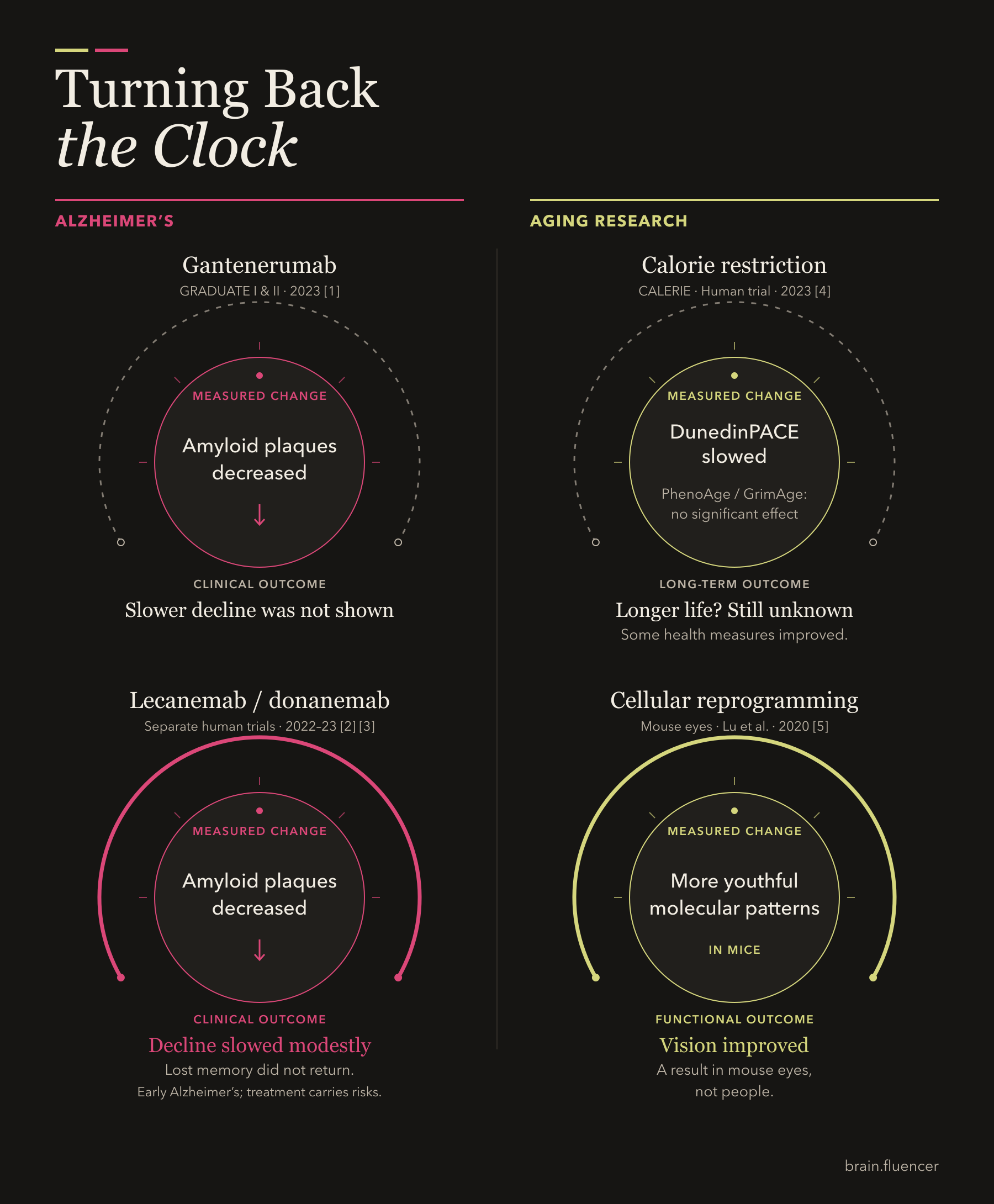
Alzheimer’s
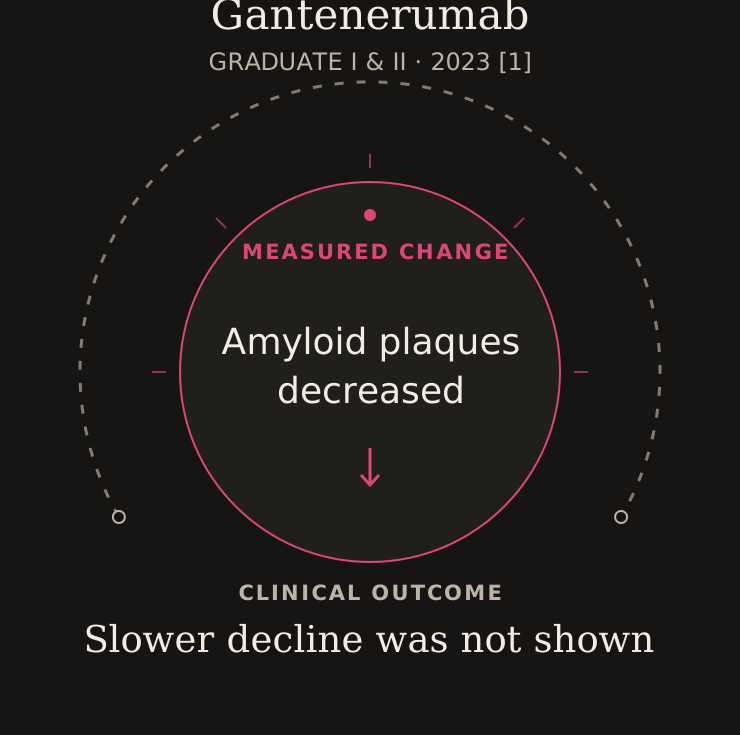
Aging research
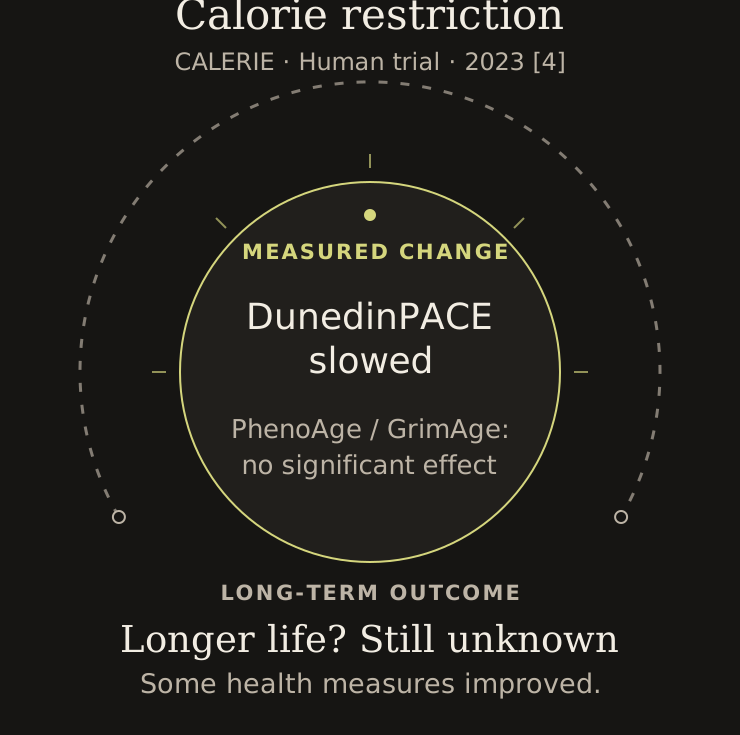
Alzheimer’s
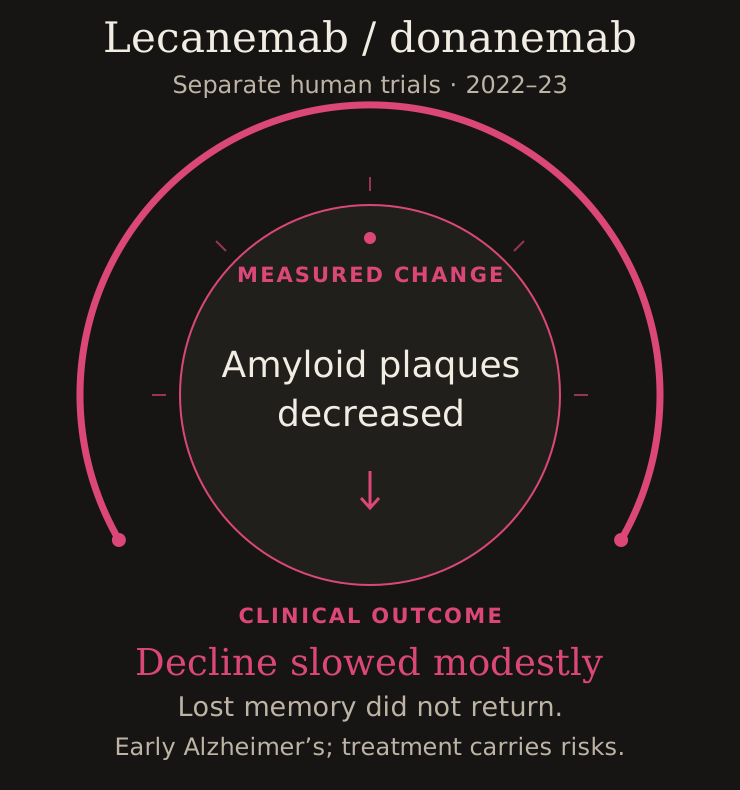
Aging research
Did the scan become the problem?
Amyloid was never an arbitrary target. Genetic discoveries, including mutations in the gene for amyloid’s precursor protein, helped establish a serious case for its role in Alzheimer’s. The amyloid hypothesis offered a biological explanation for how the disease could begin, and a reason to intervene.
But understanding how a disease begins is not the same as knowing everything that determines its course. People can have amyloid in the brain while still thinking and functioning well. Adding information about tau, another protein involved in Alzheimer’s, helps distinguish people at different levels of risk for decline.
The word biomarker does not settle these questions. It describes a measurable indicator of biology. A biomarker might help identify a disease, show that a treatment has reached its target, or help estimate what happens next. In that last role, a prognostic biomarker helps anticipate the course of illness. Being useful for one purpose does not make a measurement equally useful for every other purpose.
A marker can forecast decline because it contributes to the damage, because it records damage already done, or because both reflect another process. Those possibilities matter enormously when we decide what to treat.
To substitute a biomarker for a clinical outcome, we need evidence that treatment-induced changes reliably predict benefit in the relevant setting. That is the work required to establish a validated surrogate endpoint.
The problem was not that we could see amyloid. It was what we expected the image to tell us. A scan could be biologically informative and still leave the most important treatment question unanswered.
A person experiences Alzheimer’s through lost conversations, misplaced belongings and increasing dependence. We needed to know whether removing plaques changed those experiences.
For longevity, we face the same demand in a broader form. A younger molecular profile may be interesting. Does it mean someone will remain independent longer, recover better from illness, or avoid disease?
I build these clocks, too
I am guilty of hopping on the age train myself.
My colleagues and I developed a series of models we called TauAge. In our preprint, we used DNA methylation in brain tissue to build models related to the severity of tau pathology in different brain regions, accounting for age and amyloid. These are research tools for understanding disease biology, rather than tests that tell someone how young their brain is.
That distinction matters to me because the attraction of a clock is also its danger. A complicated biological pattern becomes a number we can compare, explain and remember. The name can make the number seem more settled than the biology underneath it.
Across aging research, the targets vary substantially.
DunedinPACE was developed from physiological changes followed over two decades, then trained to estimate that pace using blood methylation. Systems Age uses blood methylation to derive scores related to eleven physiological systems, drawing on clinical and functional measures and mortality risk. One aims to estimate a pace; the other separates patterns across systems. Neither is simply reading an invisible birth certificate.
The idea extends beyond blood. FaceAge estimates age from facial photographs and has been studied for its ability to help predict survival in people with cancer. MRI-based brain-age models compare brain structure with patterns associated with age; some studies have linked an older-appearing brain with poorer function and higher mortality.
These findings can be useful without telling us how to reverse the processes they detect. A model that recognizes vulnerability in a face has not thereby shown that making the face look younger would reduce that vulnerability.
The same standard applies to my own work. If a treatment changed one of our tau-related methylation scores, we would still need to establish what happened to tau pathology and brain function.
A clock can give us a better question. We should be careful when it starts sounding like the answer.
Where age meets disease
Is aging the accumulation of diseases, some diagnosed and others quietly developing? Or does physiology itself change in ways that make those diseases more likely?
There is evidence for both, and they interact.
Researchers in the Baltimore Longitudinal Study of Aging initially tried to understand aging by separating it from disease. Their work showed why the distinction could never be clean. Arterial stiffening can increase vulnerability to cardiovascular disease; cardiovascular disease can accelerate changes in the arteries.
At the cellular level, aging research examines changes in DNA maintenance, energy production, protein handling, immune signaling and tissue repair. Shared changes in these processes may help explain why vulnerability rises across several diseases, rather than each diagnosis being an unrelated event.
That is the deeper promise of the field. If we can alter shared sources of vulnerability, perhaps we can preserve health across more than one disease.
A clock may capture some of that biology. It may also register existing illness, past exposures, or the body’s efforts to compensate. A useful prediction could combine all of these without revealing which ones we should change.
Imagine treating a particular illness and watching someone’s age estimate fall. The improvement in health could be entirely real. But the clock alone would not tell us whether the treatment had altered broader aging processes or relieved a disease burden that the model was sensitive to.
That difference matters if we want to offer the same intervention to someone without that illness.
More measurements may help untangle the problem. They do not remove the need to ask what causes what.
Amyloid’s second act
The later trials make this parallel more useful, because they resist an easy conclusion.
Both lecanemab and donanemab reduced amyloid and modestly slowed clinical decline in people with early Alzheimer’s. Neither restored lost memory or stopped the disease. Both also carried risks, including brain swelling and bleeding.
In contrast, gantenerumab reduced plaques but did not demonstrate statistically significant benefit on the main clinical outcome in two large trials.
These were separate trials, not a head-to-head comparison. Taken together, they show why changing amyloid and establishing a treatment’s benefit remain distinct tasks.
The pipeline is still evolving. Trontinemab is engineered to improve delivery across the blood-brain barrier and has advanced into phase III studies. Remternetug is also being studied, including in people with no or only mild problems with memory and function. These programs ask whether changes in delivery and treatment timing can produce better outcomes. Their promise still needs to be tested against what happens to people.
The lesson is not to abandon an informative marker when the first treatment disappoints. It is to investigate why the result differed from the expectation: the target, the timing, the delivery, the remaining damage, or some combination.
Longevity deserves that level of biological attention too. We need to know which intervention changes which process, in whom, and whether that change helps.
What comes back?
In an analysis of the randomized CALERIE trial, two years of calorie restriction slowed DunedinPACE on average. Two other methylation-based age measures did not show statistically significant treatment effects. That was evidence that an intervention could affect a measure of aging pace, not proof that people had regained years of life.
Such signals can help decide which experiments deserve larger, longer trials. We do not need to dismiss them because they leave questions open.
The more compelling experiments also ask what the tissue can do.
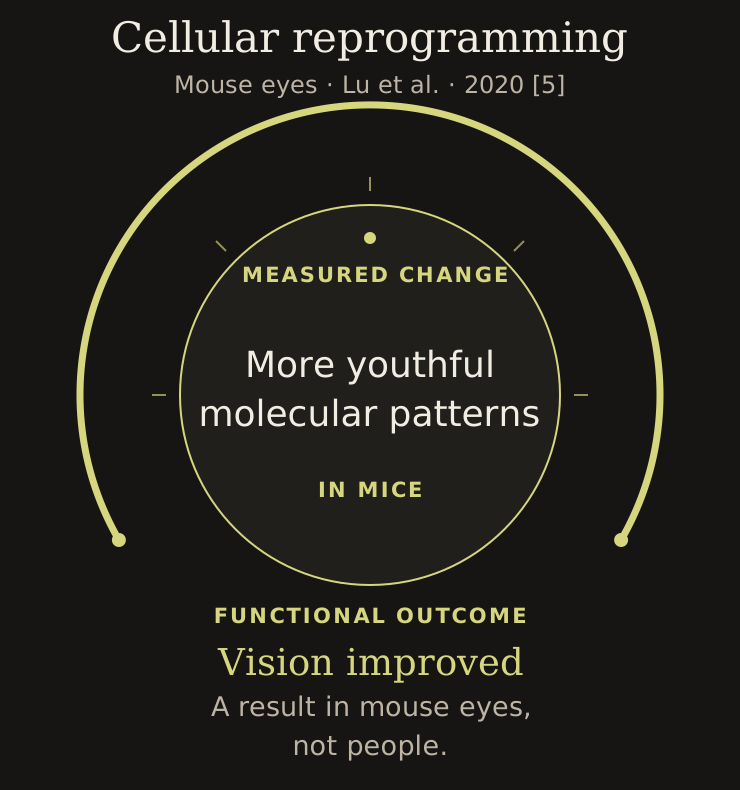
In a 2020 study, researchers altered gene activity in retinal cells in mice using factors associated with cellular reprogramming. They observed more youthful molecular patterns and improvements in visual function in aged mice and a mouse model of glaucoma. The importance was in the combination: a molecular change accompanied by an improvement in an ability the tissue had lost.
That was a result in mouse eyes, not established whole-body rejuvenation in people. But it illustrates how to move the question forward.
If we say we have rejuvenated vision, we should show that vision improves. If we say we have restored immune function, we should show that the immune system works better. The broader the promise, the broader the evidence we need, including whether benefits last and what they cost elsewhere.
A different kind of seventy
I want us to build better clocks. I also want us to keep asking questions that a clock cannot answer by itself.
A useful model can reveal vulnerability before it becomes obvious. It can help identify people who need closer attention, suggest mechanisms worth investigating, and guide the next experiment. Establishing when a changing score can stand in for benefit is a further scientific task.
Alzheimer’s research brought that distinction into focus. Removing plaques mattered because it opened a possibility. Trials measuring memory and daily function told us how much of that possibility had reached patients.
The ambition for aging should be just as concrete. At seventy, that might mean keeping your independence, recovering from illness or returning to something you thought you had lost.
If we are going to turn back the clock, we should get something back besides a number.